Before arriving, I thought the Finger Lakes were all about… well… the lakes.
I expected scenic drives, waterfront parks, and if we were lucky, charming towns. Those things certainly exist, but what surprised me most was how much of the region’s beauty lies away from the shoreline. Some of our favourite things to do in the Finger Lakes turned out to be exploring towering waterfalls, deep gorges, quiet forests, wildlife refuges and hidden overlooks.
Ironically, my first glimpse of the Finger Lakes didn’t come from the shore at all. It came from the top of a fire tower.
Sugar Hill Equestrian Campground

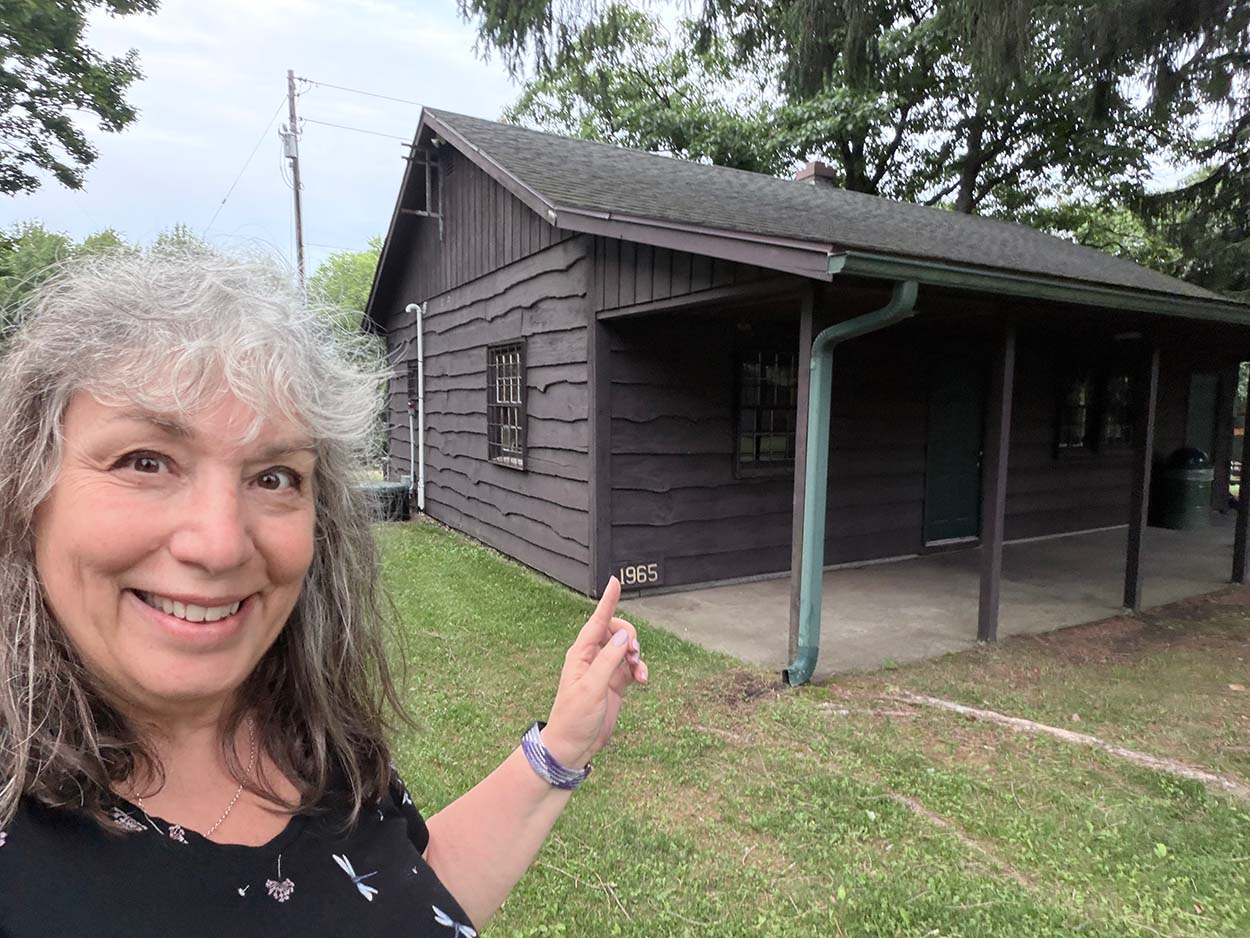
After leaving Corning, we searched for a place to spend the night and found ourselves following an iOverlander recommendation into Sugar Hill State Forest. A sign for an equestrian campground caught our attention, so we turned in to have a look. What we discovered became my favourite campground of the entire trip.
This was my first experience staying at a New York State campground in many years and, although I didn’t know it at the time, it proved to be typical of the care and maintenance that goes into the state’s parks and forests. Even better, it was completely free.
The campground is semi-primitive, but each spacious campsite includes a picnic table and fire ring, and visitors can stay for up to two weeks at no charge after checking in. Our campsite backed onto the woods, and with no immediate neighbours, it was wonderfully quiet. Since it’s an equestrian campground, there were horses nearby as well—something I never tire of admiring.
Fire Tower Views of the Finger Lakes
While I settled in around camp, James wandered off to investigate a tall metal fire tower nearby. When he returned, he told me there was a view of the Finger Lakes from the top.
Well… now I had to climb it.

With my knee still giving me trouble, I wasn’t worried about getting to the top nearly as much as I was about getting back down again. The tower looked like something straight out of a New York City fire escape, and as I climbed, it sounded like one too. It was roughly the equivalent of climbing six flights of stairs.
I told myself that if I had to come down on my backside one step at a time, then that’s exactly what I’d do. I wasn’t about to miss the view.
Thankfully, I had the tower to myself, so I could climb at my own pace without feeling rushed. At the top was a small glassed-in lookout with a well-worn wooden table covered in years of graffiti. Beyond it, the late afternoon sun was beginning to sink toward the horizon, illuminating the forests below and the long, narrow lakes stretching into the distance. I believe the lakes I was looking at were Seneca and Keuka.
Standing there, I realized this was my first official glimpse of the Finger Lakes. Not from the shoreline as I’d imagined, but from high above the trees.
Eventually, the lowering sun reminded me it was time to tackle the trip back down. The first few flights weren’t as difficult as I’d feared. By the fourth, I resorted to shuffling down a few steps on my rear end, but eventually I made it safely back to the ground.
By the time we settled in for the evening, a few more campers had quietly arrived and pitched their tents on either side of us. Another RVer had invited us to join them around their campfire, but after a full day on the road, an early night sounded much more appealing. By morning, the tenters were already gone, out exploring the Finger Lakes while we enjoyed one last peaceful cup of coffee before beginning our own adventure.
Sugar Hill gave me far more than a free place to spend the night. It gave me my first view of the Finger Lakes—and set the tone for the natural discoveries that would follow over the next few days.
Waterfalls and Hiking at Watkins Glen State Park
After leaving Sugar Hill State Forest, we made our way to Watkins Glen after hearing there was a beautiful gorge nearby. I wasn’t entirely sure what to expect, but I certainly wasn’t prepared for what we found.

Our first attempt to visit Watkins Glen State Park didn’t go quite as planned. GPS directed us to the Upper Entrance behind the town, where we quickly realized there wasn’t an easy way to access the gorge from where we’d expected. With our truck camper making downtown parking a little more challenging, we eventually found the South Entrance, where there was plenty of room to park despite there not being designated oversized vehicle spaces.
Our original plan was simple—we’d walk over, take a quick look into the gorge, and decide whether it was worth exploring further.
That plan lasted about five minutes.
After following the path down toward the Gorge Trail, we passed Lily Pond, where visitors had gathered to watch fish, turtles and frogs. We hardly slowed down. We had come to see the gorge.
I wasn’t sure how my knee would hold up, but after climbing the fire tower the evening before, I’d already decided that if it became too painful, I’d simply turn around.
As it turned out, I never did.
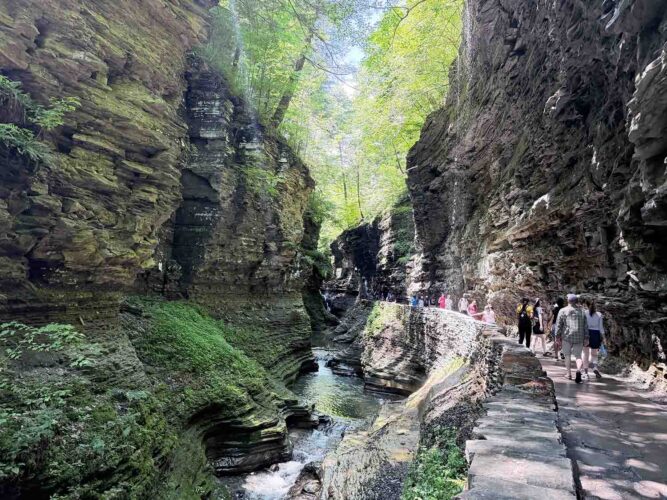
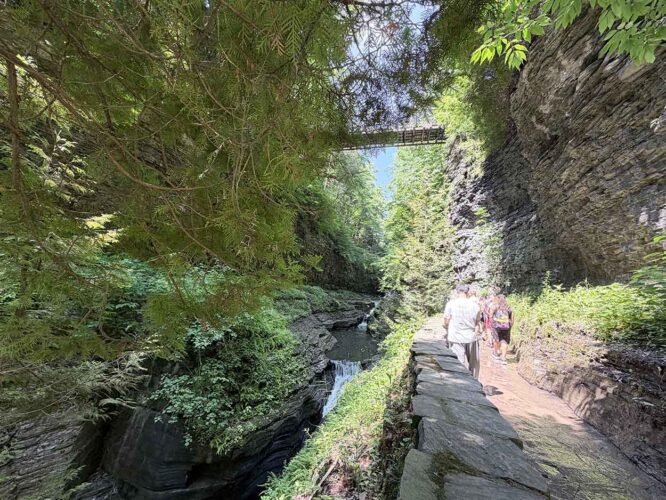
Crossing the suspension bridge, I caught my first glimpse of the gorge and immediately wanted to see more. One section of trail toward town was temporarily closed, likely due to recent flood damage, so we headed in the opposite direction where the stone walkways and bridges wound deeper into the canyon.


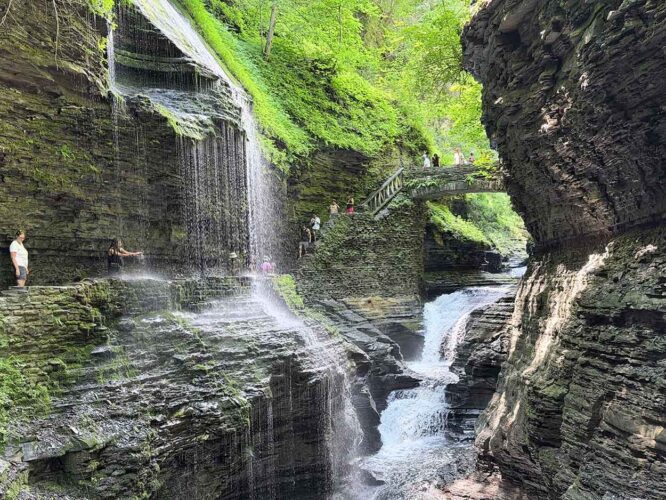
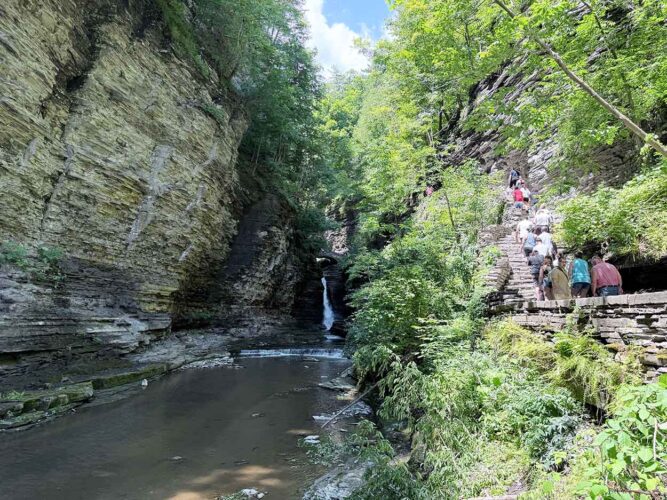
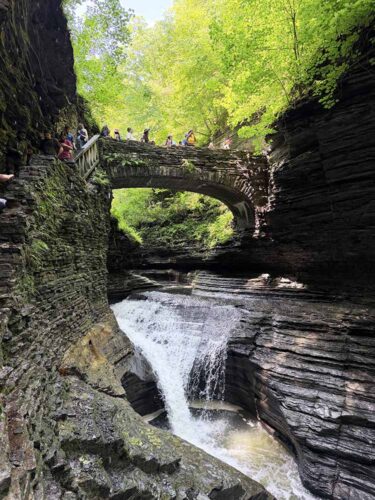
Watkins Glen State Park has been attracting visitors since the mid-1800s, when local residents recognized the beauty of the gorge and worked to preserve it for future generations. Today, the two-mile Gorge Trail passes through a narrow canyon carved by Glen Creek, crossing stone bridges and passing 19 waterfalls along the way. It’s easy to understand why it has become one of New York’s most visited state parks.
We took our time through the gorge—me stopping occasionally to rest my knee, and James stopping every few minutes to set up his tripod for another photograph. We were both perfectly content moving at our own pace.
One of my favourite scenes came where a waterfall cascaded directly over the trail while another tumbled beneath a historic stone bridge. Even with dozens of people stopping for photos, it still felt like something out of a storybook.
Then James noticed something I would have walked right past—a tiny snake making its way up the steep gorge wall. I tried to capture a better video, but it disappeared almost as quickly as we’d spotted it.
Eventually, we reached Jacob’s Ladder, the park’s famous 180-step stone staircase leading to the Upper Entrance. By then, I’d run out of water, the afternoon heat was building, and neither of us felt like retracing our steps through the gorge. Instead, we boarded the shuttle back to the South Entrance for $6 per person—a decision our legs were more than happy with.
Watkins Glen wouldn’t be the last of the Finger Lakes waterfalls we’d discover.






Camping at Sampson State Park
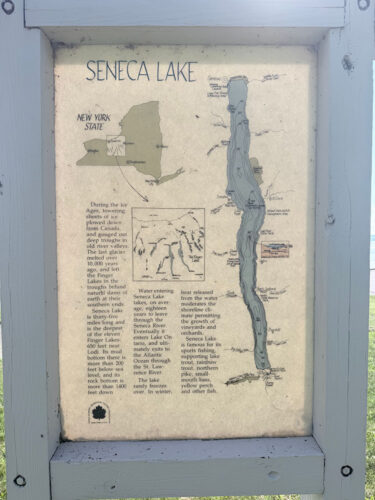
Sampson State Park offered a completely different camping experience than Sugar Hill State Forest. Instead of a quiet forest campground, we found ourselves camping beside the largest of the Finger Lakes.
Not expecting many campsites to be available, we were pleasantly surprised to have several to choose from, although none overlooked the lake itself. Before setting up camp, we drove down to the waterfront and spent some time walking hand in hand along Seneca Lake, enjoying the breeze after another warm day of exploring.
Although many campers recommend staying for the sunset, we decided to return to our campsite, connect the utilities and relax. With more hiking planned for the following day, an early evening seemed like the better choice.
What I didn’t fully appreciate until later was Sampson’s remarkable history.
During World War II, the site became Sampson Naval Training Station, where more than 400,000 sailors received basic training. After the war, it briefly reopened as a U.S. Air Force training centre before eventually becoming the state park visitors enjoy today. Reminders of that history can still be found throughout the park, including the Sampson Veterans Memorial Cemetery and the Sampson Veterans Memorial Museum.
We briefly considered extending our stay to rent a boat and spend more time exploring the military history, but with so much of the Finger Lakes still waiting to be discovered, we reluctantly decided to continue our journey.



Visiting Taughannock Falls State Park
Instead of following Seneca Lake all the way back to the southern end, we cut across mid-lake toward Cayuga Lake with one destination in mind—Taughannock Falls.
Following the signs to the visitor centre, we were happy to find dedicated RV parking, although many of the oversized spaces had been taken by passenger vehicles—a bit of a pet peeve of mine. Fortunately, there was just enough room behind one of the cars for us to squeeze in.
Crossing the road to the overlook, I was immediately struck by the sheer scale of the falls.

At 215 feet (66 metres), Taughannock Falls is the tallest single-drop waterfall east of the Rocky Mountains. The surrounding gorge walls rise nearly 400 feet above the creek, making the waterfall appear even more dramatic from the overlook.
The viewing platform sits directly across the gorge, offering an unobstructed view of the falls as they plunge into the basin below.
Far beneath us, hikers made their way along the Gorge Trail toward the base of the waterfall. We briefly considered joining them, but with the midday heat, very little visible shade and more stops still ahead of us, we decided we were perfectly happy enjoying the view from above.
As we pulled out of the parking lot, a sign pointing toward the nearby village of Trumansburg caught our attention. On a whim, we turned to see what we might find.
Founded in 1872, Trumansburg is a small village with a welcoming main street of locally owned shops and cafés. I briefly considered stopping for a coffee, but the afternoon heat—and the miles still ahead of us—convinced us to continue toward Ithaca instead.
Unexpected Ithaca Falls
We had hoped to explore Ithaca, but finding suitable parking for the truck camper proved difficult, so we continued on without seeing the downtown area.
As we were leaving town, we crossed a bridge and a wide waterfall suddenly came into view. Fortunately, the nearby school parking lot was empty, giving us plenty of room to park before walking back across the bridge to explore Ithaca Falls.

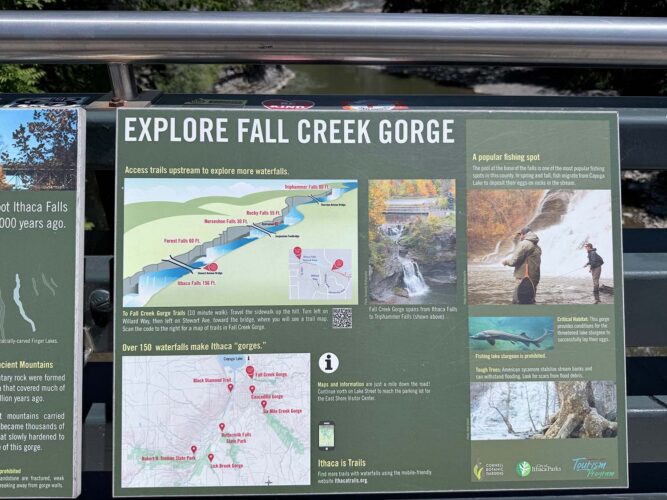

A short trail led us closer to the waterfall. I loved that such an impressive natural wonder could exist right in the middle of a city. People wandered along the trail, watching the water spill over the broad rock ledge, taking photographs and simply enjoying the moment. The flat rock along the riverbank even provided the perfect place to sit and dangle your feet in the water.

While James was happily setting up his tripod and photographing the falls, I found myself watching the people instead. A young woman, beautifully dressed and on her way to a wedding, was trying to take a photo of herself with the waterfall in the background. I offered to help, and after that it seemed to become my unofficial job for the afternoon. Before long, I was taking photos for couples and families who wanted to remember their visit too.
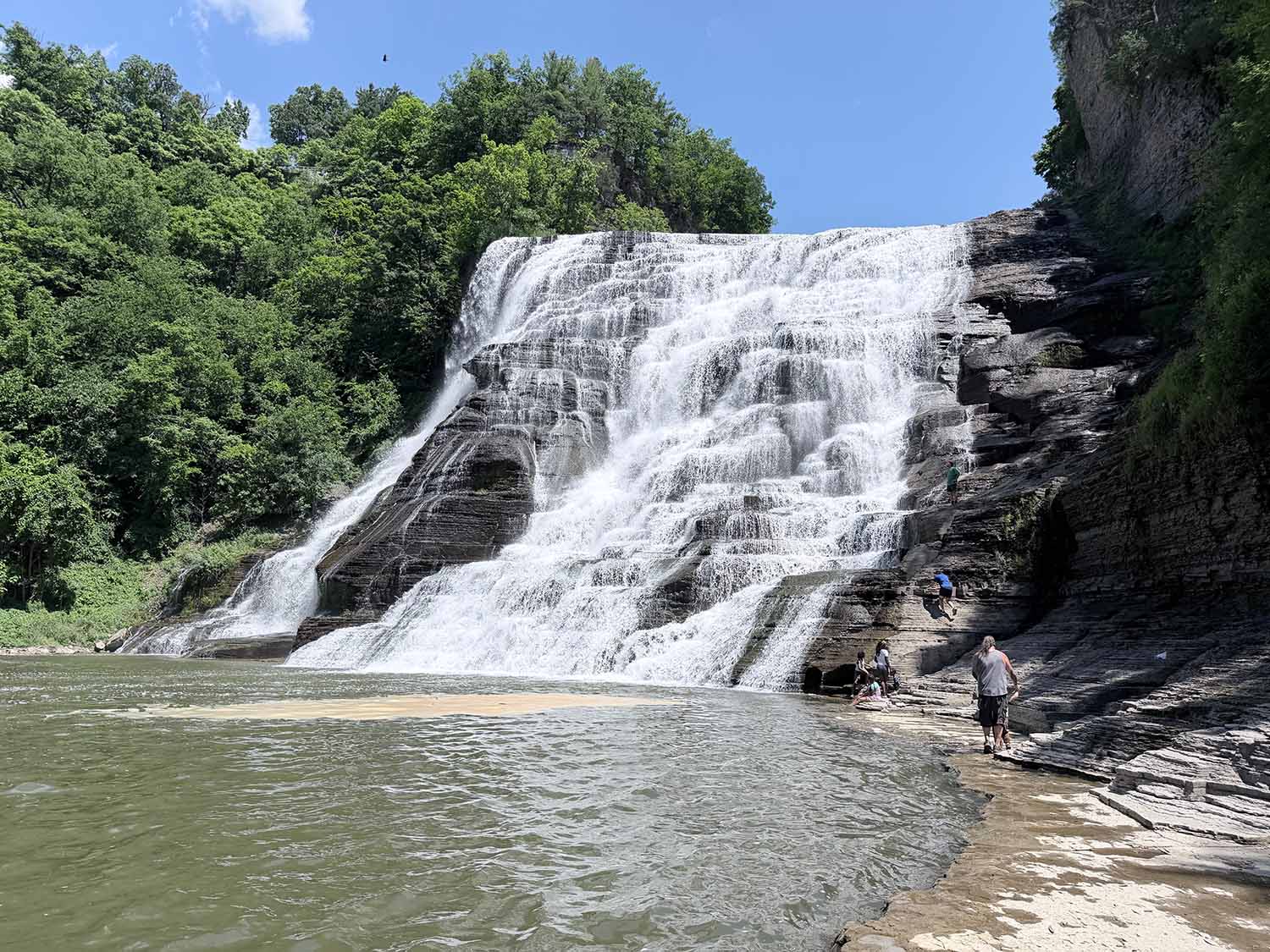
Although we never did make it into downtown Ithaca, we left with more than a few photographs. We left with smiles, friendly conversations and the reminder that sometimes the nicest part of travelling isn’t just discovering beautiful places—it’s sharing them with other people.
Waterfalls in the Finger Lakes
With 19 waterfalls at Watkins Glen, the 215-foot Taughannock Falls and Ithaca Falls appearing almost unexpectedly in the middle of the city, waterfalls became one of the highlights of our Finger Lakes trip.
Relaxing at Myers Park
After several days of hiking trails and chasing waterfalls, we decided it was finally time to slow down and experience the lakes themselves. Myers Park, on the western shore of Cayuga Lake, seemed like the perfect place to do just that.
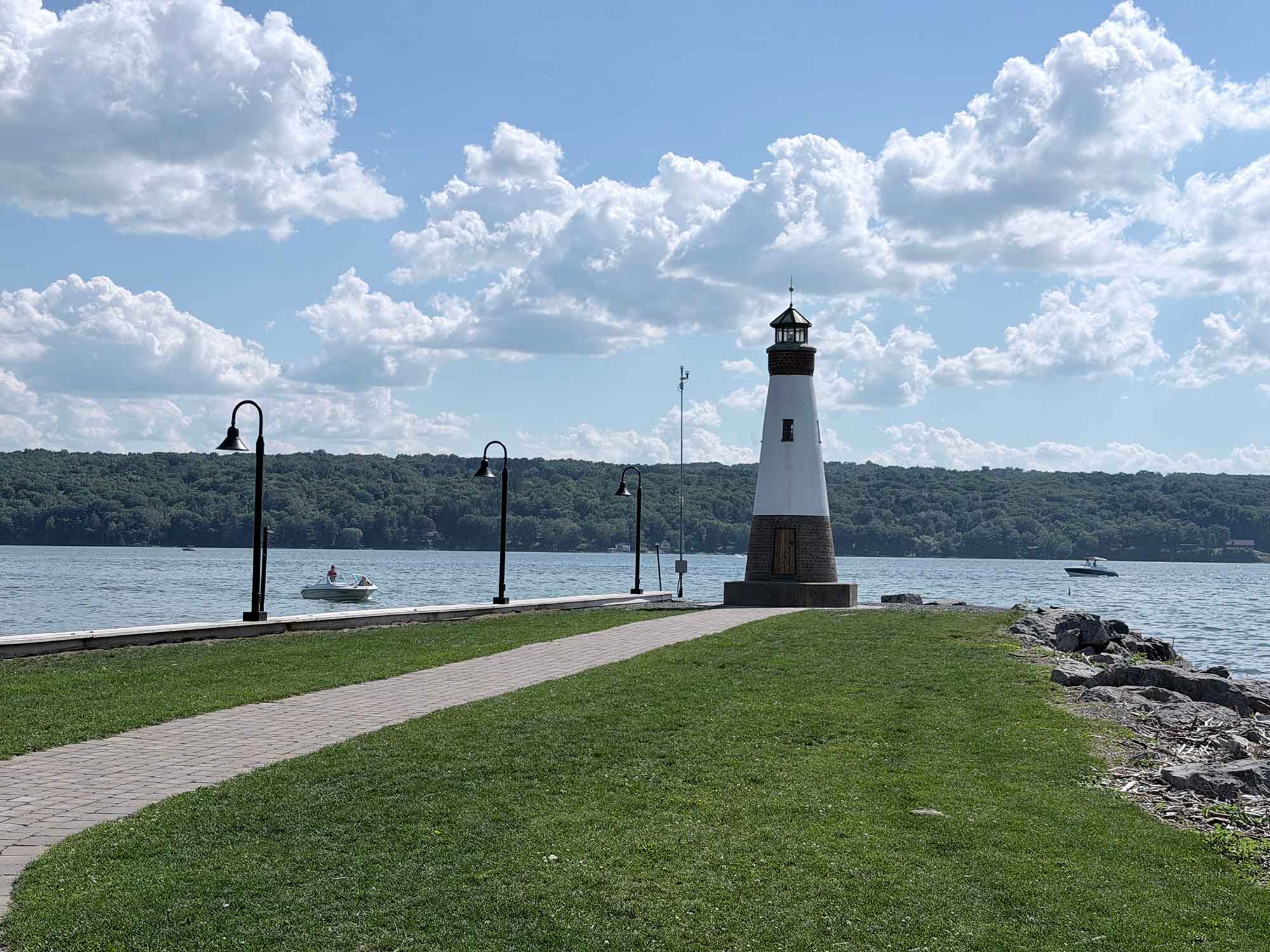
After paying the day-use fee and confirming we could get in with the truck camper, we started toward the lake when a man in a golf cart came speeding over, waving us down. At first, I thought we’d done something wrong. Instead, he explained that the parking area ahead would be too tight for our camper to turn around safely.
Since he worked at the adjoining campground, he offered to let us park on the grass instead. It was one of those small acts of kindness that can completely change your day.
We happily accepted, grabbed our folding chairs and wandered down to the waterfront.
For the next little while, we did almost nothing.
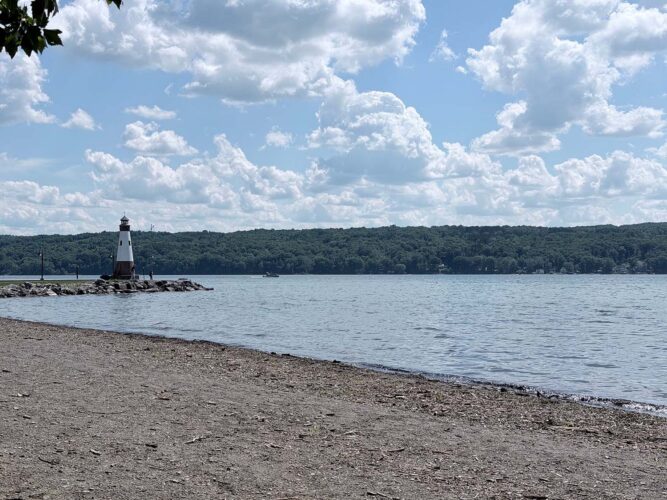
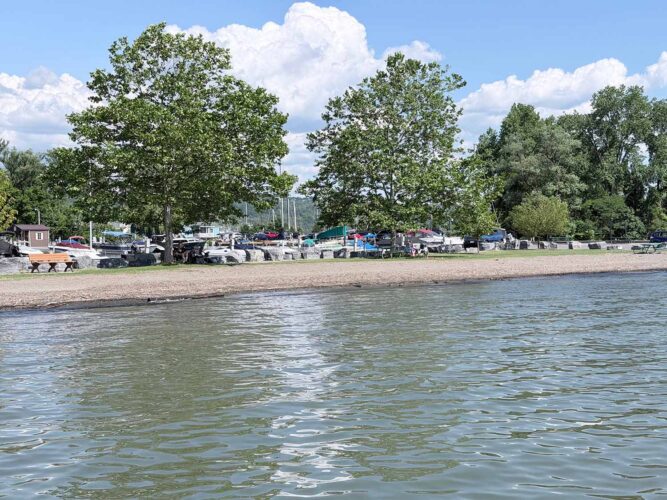
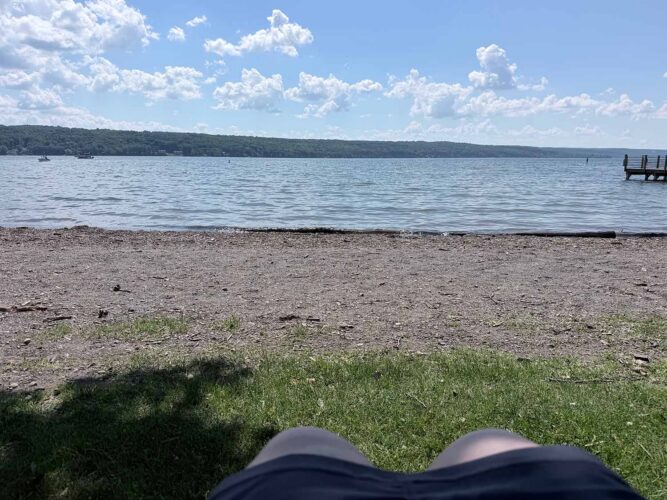
We sat beneath the shade of a tree, watched families enjoying the beach, scrolled through our phones, and simply enjoyed the slower pace. Behind us, boats drifted in and out of the marina while a small lighthouse marked the harbour entrance. It wasn’t dramatic or adventurous like some of our other stops, but it was exactly what we needed.
Road trips don’t always have to be about seeing one more attraction. Sometimes the best part of the day is simply finding a quiet place to sit beside the water and enjoy where you are.
Exploring Montezuma National Wildlife Refuge
After spending a relaxing afternoon on Cayuga Lake, we continued north along the eastern shoreline. While looking over the map, I noticed Montezuma National Wildlife Refuge sitting at the northern tip of the lake. Since neither of us had heard much about it, curiosity got the better of us.
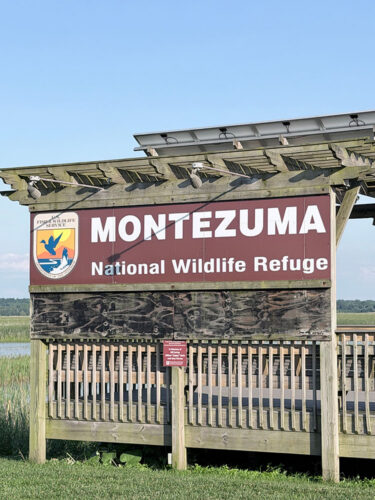


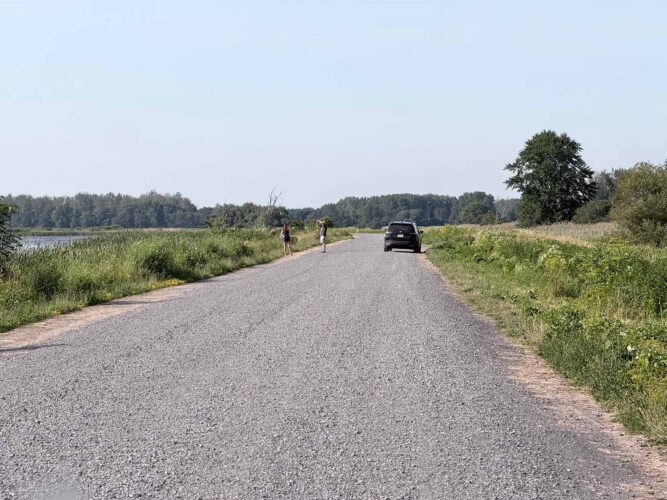
For some reason, I imagined it would be similar to a drive-through wildlife park like African Lion Safari in Ontario or Wildlife Safari Park in Nebraska. In reality, the only thing they had in common was that you explored them from your vehicle.
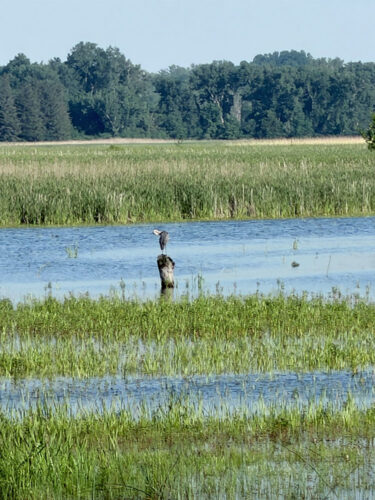
Instead of bison, elk or giraffes, Montezuma is all about birds.
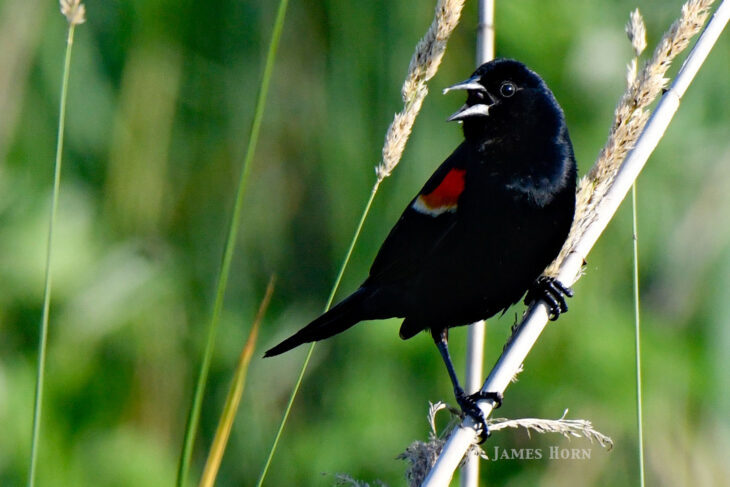

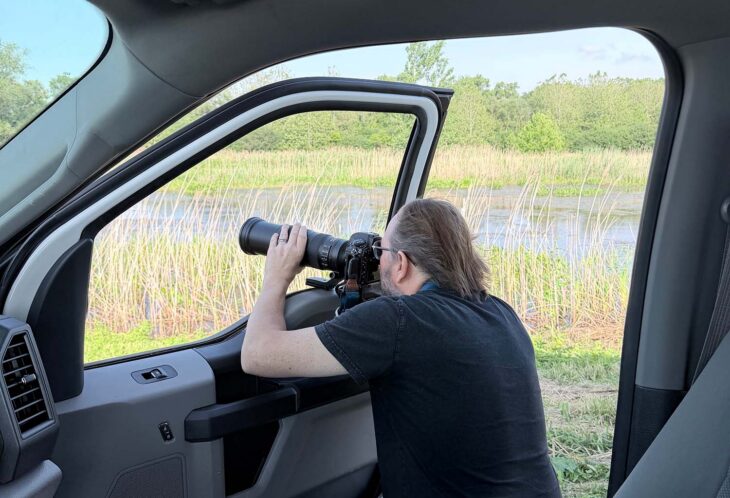
That was perfectly fine with James. Armed with his long lens, he happily photographed as many species as he could find while I enjoyed the peaceful drive through the wetlands.
We assumed the Wildlife Drive would loop back to where we’d entered, but instead we found ourselves exiting near Interstate 90. The birds didn’t seem to mind the highway noise nearly as much as I did.


Watching Fireflies Along the Erie Canal
Thanks once again to iOverlander, we found a quiet place to spend the night near the Erie Canal locks.
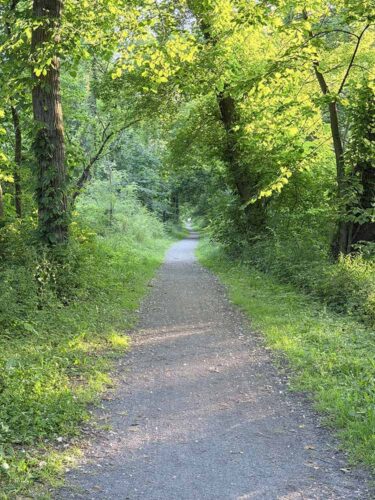

As dusk settled in, the first tiny flashes of light began appearing among the trees.
I couldn’t remember the last time I’d seen so many fireflies. Growing up, summer evenings seemed to be filled with them. Later, when I lived in subdivisions, they seemed to survive only in the yards that weren’t so carefully manicured.
Whether it was the longer grass, fewer chemicals, or simply more natural habitat, I began to wonder what we’d lost in our pursuit of perfect lawns.
Then darkness settled over the Erie Canal. Hundreds—perhaps thousands—of fireflies began blinking in every direction. I sat there watching them until I couldn’t keep my eyes open any longer.
When I first planned this trip, I imagined leisurely drives with lake views around every bend. Instead, I found that the lakes themselves often appeared only in glimpses between trees, cottages and vineyards. The real magic of the Finger Lakes wasn’t found from the driver’s seat.
It was waiting at the waterfalls, along hiking trails, in quiet campgrounds, throughout wildlife refuges and in all the little places that encouraged us to stop and explore.
And looking back, I’m glad we didn’t spend our days simply circling the lakes. The memories I brought home came from wandering a little farther, climbing to one more viewpoint, following another trail and sitting still long enough to watch thousands of fireflies light up the night.
Frequently Asked Questions About Things to Do in the Finger Lakes
The Finger Lakes offer far more than beautiful lakes. Some of my favourite natural things to do included hiking through the gorge at Watkins Glen State Park, viewing Taughannock Falls from above, stumbling across Ithaca Falls, climbing the fire tower in Sugar Hill State Forest, relaxing beside Cayuga Lake and driving through the wetlands at Montezuma National Wildlife Refuge.
There are plenty more outdoor experiences throughout the region, from hiking and biking trails to boating, fishing and additional state parks. If nature is what brings you to the Finger Lakes, you could easily fill several days without visiting a single winery.
You won’t have to look very hard. Waterfalls in the Finger Lakes are especially concentrated around Ithaca and the southern ends of the lakes.
We visited three very different waterfall destinations. Watkins Glen State Park packs 19 waterfalls into a two-mile gorge; Taughannock Falls plunges 215 feet into a gorge near Cayuga Lake; and Ithaca Falls is a 150-foot cascade that seems almost improbably tucked into the city of Ithaca.
Those are only a few of the waterfalls in the region. Around Ithaca alone you’ll also find Buttermilk Falls, Lucifer Falls, Triphammer Falls, Cascadilla Falls and many others.
Some of the most memorable experiences from our trip weren’t necessarily the famous attractions. We climbed the fire tower in Sugar Hill State Forest for a view across the Finger Lakes, camped at a free equestrian campground, drove through wetlands looking for birds at Montezuma National Wildlife Refuge and spent an evening watching what seemed like thousands of fireflies flashing beside the Erie Canal.
We also discovered a couple of places around Otisco Lake that I’d like to return to. Otisco Lake Park is a tiny three-acre park along the shoreline with benches, evergreens and fishing access. When we stopped, it was wonderfully peaceful and we practically had it to ourselves. The parking area isn’t RV-friendly, but smaller, low-profile vehicles such as vans should have no trouble getting in and out.
Across the lake, Otisco Lake Preserve protects more than 1,300 feet of undeveloped shoreline and habitat for Bald Eagles and other water birds. A short but steep trail descends through the forest to the water’s edge. We considered hiking it, but on an already hot day, knowing we’d have to climb all the way back up convinced us to save that adventure for another visit.
There really isn’t one best time to visit the Finger Lakes—it depends on what you want to experience.
Summer is ideal for hiking, boating, swimming and spending long days outdoors, although temperatures can reach the upper 80s and low 90s and thunderstorms are possible. Fall transforms the hillsides with red, orange and gold foliage, with peak colour typically occurring around the second or third week of October. Spring brings the landscape back to life and can be a beautiful time for outdoor exploration, while winter offers an entirely different Finger Lakes experience with snow-covered landscapes and winter recreation.
We visited in early summer, which gave us long days for hiking and exploring, although the heat definitely influenced a few of our decisions along the way.
Absolutely. Some of the most impressive natural attractions in the Finger Lakes require very little walking.
The Taughannock Falls overlook is a short distance from a paved parking lot and provides a spectacular view across the gorge. Montezuma National Wildlife Refuge has a three-mile Wildlife Drive that allows you to look for birds and other wildlife without leaving your vehicle. And lakeside parks provide plenty of opportunities to simply sit beside the water, picnic or enjoy the scenery.
Hiking will open up many more possibilities—particularly at places like Watkins Glen—but you certainly don’t have to be an avid hiker to enjoy the natural beauty of the Finger Lakes.
Definitely. That may have been the biggest surprise of our trip.
Before we arrived, I associated the Finger Lakes primarily with the lakes themselves, charming towns and wineries. Instead, some of our strongest memories came from waterfalls, deep gorges, forests, wildlife habitats and hiking trails. The region covers a remarkably varied landscape with state parks, nature preserves and outdoor recreation opportunities throughout it.
The wineries and towns are certainly part of the Finger Lakes experience—and we enjoyed those too—but you could plan an entire Finger Lakes getaway around nature and still leave with places you didn’t have time to explore.